
Scenarios & Evidence · Evidence literacy
AI Risk Scenarios and Evidence: How to Assess Claims
Claims about AI catastrophe can feel urgent, confusing, or frightening. A useful response is neither automatic belief nor dismissal. It is careful separation of what has been observed, what is being forecast, and what remains uncertain—followed by practical preparation proportionate to credible risks.
Reading time: about 8 minutes · Guide: source review and household decision-making
First, name what kind of statement you are reading
Strong headlines often compress several different claims into one sentence. Unpack them before deciding how much weight to give them. These categories are not interchangeable:
Scenario
A conditional account of how harm could occur. It describes a chain of events and dependencies, not proof that this chain will happen. Ask what capabilities, access, human decisions, and safeguards the scenario assumes.
Forecast
A judgment about likelihood, timing, or future capability. Check its time horizon, definition of the outcome, and basis. A forecast is not an observed event.
Observed fact
A documented event, measurement, test result, or system behavior. Confirm what was measured, under what conditions, and whether others can inspect the evidence.
Interpretation
An explanation of what evidence may mean. Two readers may agree on the observation but disagree about its significance, generalizability, or implications for future systems.
Uncertainty
Limits in evidence or knowledge: unknowns about capability, deployment, safeguards, human behavior, or future change. Naming uncertainty improves judgment; it does not mean every outcome is equally likely.
For example, a demonstration in a controlled test might establish that a system performed a particular task under those test conditions. It would not by itself establish that the same behavior occurs reliably in ordinary use, that a real-world harm has happened, or that a catastrophe is inevitable. Keep each inference attached to evidence supporting it.
How to evaluate AI catastrophe claims
Read beyond the headline. Identify the exact claim and its source, then trace any linked evidence to its original form. A social post quoting a report is several steps removed from the report; a report summarizing a study is not the same as independently checking the study’s methods.
01 · Identify producer
Who made the claim: researcher, company, public agency, advocacy group, journalist, or commentator? What expertise or access supports the statement? Who may have incentives that shape framing? Incentives prompt scrutiny, not automatic rejection.
02 · Follow evidence
Does the claim link to data, a technical evaluation, a documented incident, or a synthesis? Can you find the original source? Separate direct results from summaries, analogies, and conclusions.
03 · Surface assumptions
What must be true for the scenario or forecast to hold? Consider capability, access to tools or infrastructure, autonomy, reliability, human oversight, and whether safeguards fail. Missing assumptions can make a scenario seem more certain than it is.
04 · Look for revision conditions
Ask what evidence would change the author’s conclusion. A claim that cannot be revised in light of contrary evidence deserves extra caution. Check whether uncertainty, limitations, and counterevidence are represented fairly.
When comparing claims, check that they refer to the same outcome and timeframe. “Could happen,” “is plausible,” and “is likely within a stated period” mean different things. Probability estimates may reflect expert judgment or formal modeling; ask how they were elicited, what assumptions they use, and whether they should be read as precise measurement or as a structured expression of uncertainty. Never treat a dramatic number as settled fact simply because it is exact.
Use research reports as context, not certainty machines
The International AI Safety Report 2026 executive summary and its full report provide context on risks and uncertainties related to advanced AI. They can help readers understand the range of issues discussed and the evidence landscape. They do not prove that catastrophe is certain, nor do they settle every disputed forecast.
Read a synthesis with the same care as any source: note its scope, definitions, evidence cut-off, and stated limits. A broad report can help orient readers, but a particular claim may depend on a specific study or assumption not resolved by the summary. Do not infer certainty from inclusion in a report, and do not infer safety from uncertainty alone.
Accessible claim-review worksheet
Use this text worksheet while reading or discussing a claim. It does not produce an automated verdict or label a claim true or false. Its purpose is to make reasoning visible so readers can decide what to verify next.
- Claim in my own words: What exactly is being said? Preserve qualifiers such as “could,” “may,” or “by a specified time.”
- Claim type: Is this a scenario, forecast, observed fact, interpretation, or a mixture? Which part is evidence and which part is conclusion?
- Source and date: Who produced it, and where was it first published? Is the source speaking within its area of expertise?
- Evidence linked: What underlying study, test, data, or documented event is cited? Can I access enough detail to understand how it was produced?
- Key assumptions: What capabilities, access, deployment choices, or failures of safeguards does the reasoning require?
- Uncertainty and counterevidence: What limits, alternative explanations, or contrary findings are acknowledged? What relevant information is missing?
- What could change my view? Name a kind of future evidence or observation that would raise or lower confidence.
- Practical relevance: Does this claim change a sensible preparedness action, or does it mainly create urgency without a clear, proportionate step?
For conversations with family, neighbors, or colleagues, separate “I find this scenario worth preparing for” from “I believe this outcome is likely.” That distinction helps people discuss uncertainty without dismissing concern or amplifying fear. Keep notes on sources and revisit them when stronger evidence appears.
Turn uncertainty into proportionate local planning
Readers do not need to forecast the future accurately to take useful steps. Start with practical resilience that helps across many disruptions: keep important contact details accessible, agree how household members will reconnect, understand local emergency information channels, and maintain essential supplies suited to household needs. These actions do not depend on believing a specific AI catastrophe scenario.
For AI-specific concerns, think in terms of ordinary dependencies. If a service or tool is unavailable, which essential task becomes harder? Consider communications, work, access to information, and services you rely on. Identify a reasonable manual alternative where practical. Avoid drastic choices based on one unsourced post or a confident but unsupported date prediction.
Local conditions differ, so use guidance from relevant public authorities and service providers for hazards, emergency contacts, and community resources. A preparedness plan should fit household circumstances, accessibility needs, and the disruptions most relevant to your area. Review it periodically; update it when credible information or personal needs change.
Explore the site’s practical guides: Scenarios and evidence and preparedness planning.
Common questions
Does a plausible catastrophe scenario mean catastrophe is likely?
No. A scenario describes a possible chain of events under assumptions. Likelihood requires additional reasoning and evidence. Ask which steps are established, which are uncertain, and what timeframe the claim concerns.
Should I trust a source with strong incentives?
Incentives matter as context, but they do not decide whether evidence is sound. Inspect methods and links, compare independent sources where available, and look for transparent limits and counterevidence.
Can experts agree that a risk matters while disagreeing about probability?
Yes. People may agree a potential harm deserves study or safeguards while differing over assumptions, likelihood, or timing. Keep the shared concern separate from disputed estimates.
What if I cannot assess technical evidence myself?
Use the worksheet to check source tracing, definitions, assumptions, limitations, and whether multiple credible analyses are represented. You can identify missing support without needing to reproduce a technical evaluation.
Make a plan grounded in evidence and everyday resilience
Review claims calmly, record what remains uncertain, and focus on practical steps that serve your household across multiple kinds of disruption. Evidence literacy supports preparedness; it does not require certainty about the future.
Related reading
Continue with Scenarios and evidence for more guidance on reviewing AI-related risk claims.
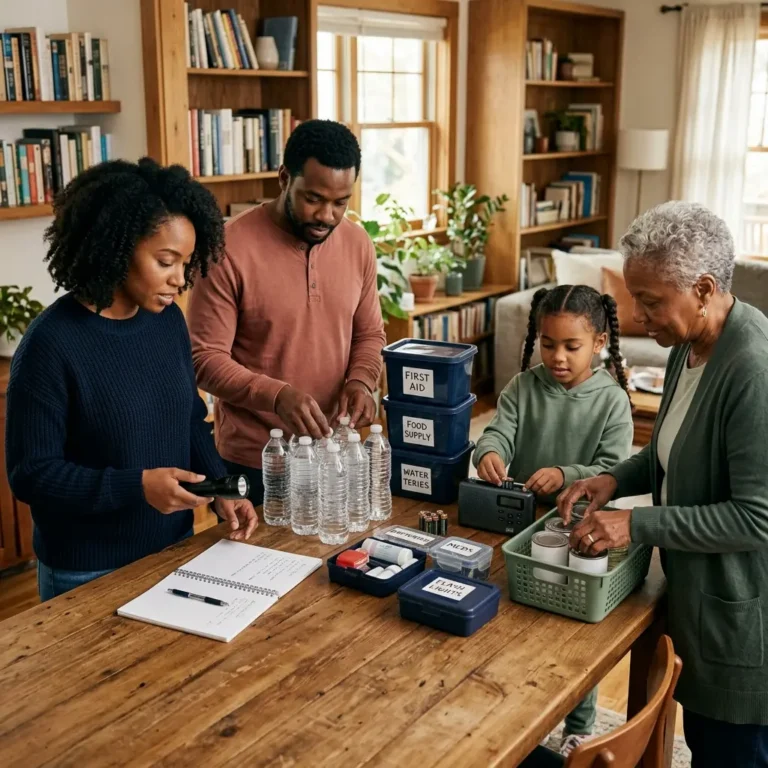
Essential Preparedness Tools: A Budget-Aware Home Guide
Choose essential preparedness tools by starting with household needs, using what you own, prioritizing affordable gaps, and maintaining accessible supplies.
Read article: Essential Preparedness Tools: A Budget-Aware Home Guide1 articles available.
Load more articles